


Okayama Travel Guide
Okayama is a strong Japan travel destination for gardens, castles, canal towns, art islands, fruit, and Setouchi travel connections.
Quick facts
- Best for: gardens, castles, canal towns, art islands
- Recommended stay: 1 to 3 days
- Best season: Spring, autumn, and key local festival seasons
- Main bases: Korakuen Garden, Okayama Castle, Kurashiki, Naoshima gateway
Why visit Okayama
Okayama is the hinge between Honshu and Shikoku, and it is worth stopping rather than changing trains at. Korakuen is a Special Place of Scenic Beauty and one of Japan’s Three Great Gardens, laid out around three hundred years ago with wide lawns that make it feel more open than most. It sits directly across the river from the black-walled Okayama Castle. West of the city, the Kurashiki Bikan district preserves a canal lined with white-walled storehouses turned into museums and cafes. Offshore, Naoshima is the art island most people reach from this side of the water.
Getting to Okayama
Okayama is a Sanyo Shinkansen stop and the junction where the line to Shikoku branches south across the Seto-Ohashi bridge, which is why so many itineraries pass through. Kurashiki is around fifteen minutes further west on a local train and is an easy half day. For Naoshima the ferry leaves from Uno, south of the city, and the timetable rather than the museums decides your day. See Getting Around Japan for how the Sanyo line and its passes work.
Top Attractions in Okayama
Korakuen Garden
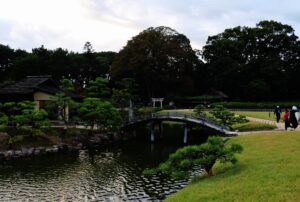
Korakuen Garden in Okayama is ranked as one of Japan's three great gardens, alongside Kenroku-en and Kairaku-en, and it pairs an open, spacious lawn-and-pond layout with a direct view toward Okayama Castle just across the river.
- Price
- Adult admission (15–64) is ¥500; seniors 65+ pay ¥200. Visitors 14 and under and students through age 18 enter free under the garden’s current policy. A Korakuen + Okayama Castle combined ticket is ¥800.
- Time needed
- Allow about 90 minutes for the garden; add roughly an hour if you are also visiting Okayama Castle across the river.
View practical details
- Best time
- Go near opening for quieter lawns and water views; check the official seasonal calendar before a blossom or foliage visit.
- Good for
- Garden lovers, photographers, families, and travelers pairing Korakuen with Okayama Castle.
What to do
- Start at the Main Gate and follow the broad lawns, ponds, and tea fields before choosing one of the castle-view viewpoints across the Asahi River.
- Use the free guest Wi-Fi with the Global Guide App, or buy the ¥500 audio-guide QR sheet at the Main Gate Information Center if you want interpretive context in English and other languages.
- For a guided visit, volunteer guides receive visitors from 9:00 to 16:00 (last reception 15:30); foreign-language reservations are recommended, but the service and advance reservations pause in August.
- Pair Korakuen with Okayama Castle on the same walkable riverside outing rather than treating the two as separate trips.
Tickets and fees
Checked in August 2026: Korakuen is open daily. From March 20 to September 30, hours are 7:30–18:00 with last entry at 17:45; from October 1 to March 19, hours are 8:00–17:00 with last entry at 16:45. Adult admission is ¥500 and the combined Korakuen + Okayama Castle ticket is ¥800. Re-entry is not permitted, so plan your castle stop before you pass the gate.
Getting there
From JR Okayama Station, walk about 25 minutes, or take the simpler 12-minute option: Okaden bus no. 18 for Fujiwara Danchi from platform 1 to Korakuen-mae. The Higashiyama-bound streetcar reaches Shiroshita in about 15 minutes, followed by a walk across the Asahi River. Okayama Castle is directly across the river, so combine both on foot.
Nearby
Okayama Castle is a short walk across the river; see our Okayama Castle guide. For a half-day or full-day trip further out, the Kurashiki Bikan District is about 20 minutes away by train.

Okayama Castle
Okayama Castle, nicknamed Ujo or 'Crow Castle' for its black-lacquered exterior, is a rebuilt keep on the Asahi River that gives a compact, easy castle visit right next to Korakuen Garden.
- Price
- Paid. Adult admission is around yen 320; children pay around yen 100. A combo ticket with Korakuen Garden is available for about yen 800.
- Time needed
- 45 minutes to 1 hour.
View practical details
- Best time
- Late afternoon light suits the black exterior, and evening illumination runs during some seasonal periods.
- Good for
- History fans, families, and travelers combining it with Korakuen Garden.
What to do
- See the black-lacquered exterior that gives the castle its Crow Castle nickname, a contrast to the white castles common elsewhere in Japan.
- Go up through the reconstructed keep's exhibits on the castle's history and the Ikeda clan who once ruled here.
- Try on a samurai or princess costume at the photo corner inside, a popular option with kids.
- Cross the river on foot to combine the visit with Korakuen Garden, which sits directly opposite.
Tickets and fees
Checked in July 2026: gate tickets are simple to buy on arrival and the castle is rarely crowded enough to need advance booking. If you plan to see Korakuen Garden the same day, buying the combined ticket at either site is a small saving over two separate admissions.
Getting there
About a 25-minute walk from JR Okayama Station, or take the Okayama Castle/Korakuen loop bus or a tram plus short walk. The castle is a short walk from Korakuen Garden across the Asahi River.
Nearby
Korakuen Garden faces the castle across the river; see our Korakuen Garden guide. The Kurashiki Bikan District makes a good add-on about 20 minutes away by train.

Kurashiki Bikan District
The Kurashiki Bikan Historical Quarter is a preserved canal-side merchant district of white-walled storehouses turned into shops, cafes, and museums, and it makes an easy half-day trip from Okayama City.
- Price
- Free to walk the district. Individual sites charge separately, including the Ohara Museum of Art at around yen 2,000.
- Time needed
- 2 to 4 hours, longer if you visit the Ohara Museum or take a canal boat ride.
View practical details
- Best time
- Weekday mornings for fewer crowds; evenings for lantern-lit canal views.
- Good for
- History and architecture fans, art museum visitors, couples, and photographers.
What to do
- Walk the canal lined with willow trees and Edo-period white-walled storehouses (kura).
- Visit the Ohara Museum of Art, one of Japan's oldest Western art museums, if you have time to spare.
- Take a short traditional boat ride along the canal for a different view of the district.
- Browse the former storehouses now used as craft shops, cafes, and small museums, including the Japan Rural Toy Museum and Kurashiki Ivy Square.
Tickets and fees
Checked in July 2026: the district itself needs no ticket, so you can arrive and walk in freely. The Ohara Museum and canal boat rides have limited capacity and separate fees, and the museum is closed on Mondays (unless a national holiday), so check hours before building your schedule around them.
Getting there
About a 15-minute walk south from JR Kurashiki Station, which is roughly 15 to 20 minutes from JR Okayama Station on the JR Sanyo Line.
Nearby
Combine with Okayama City sights such as Okayama Castle and Korakuen Garden, both about 20 minutes away by train.

Naoshima (Art Island)
Naoshima is a small island covered in contemporary art museums, outdoor installations, and art houses tucked into an old fishing town, and although it administratively belongs to Kagawa Prefecture, most visitors reach it by ferry from Uno Port in Okayama, which makes it a natural stop on an Okayama itinerary.
- Price
- Paid per site. Chichu Art Museum runs around yen 2,500 online on weekdays and more on weekends; Benesse House Museum and other sites charge separately, roughly yen 1,000 to 1,300 each.
- Time needed
- A full day for a first visit; two days if you want to see most museums and art houses without rushing.
View practical details
- Best time
- Weekdays outside spring (April-May) and autumn (October-November), when the island is at its busiest.
- Good for
- Art and architecture fans, photographers, and travelers wanting a slower, scenic day away from the cities.
What to do
- See the Chichu Art Museum, built mostly underground by Tadao Ando, with works by Monet, Walter De Maria, and James Turrell.
- Walk the Art House Project in Honmura, where several old houses have been converted into individual art installations.
- Visit Benesse House Museum, which combines a hotel, museum, and outdoor sculpture in one Ando-designed complex.
- Photograph Yayoi Kusama's yellow and red pumpkin sculptures near the waterfront, some of the island's most recognizable landmarks.
Tickets and fees
Checked in July 2026: advance online booking is required for the Chichu Art Museum and for some Art House Project sites and galleries, and spring and autumn slots can sell out weeks ahead, so book through the official Benesse Art Site Naoshima website as early as you can. Other sites are more flexible about walk-in entry, but confirm current rules before you go.
Getting there
From Okayama Station, take the JR Uno Line to Uno Station (about 1 hour), then a ferry to Miyanoura Port on Naoshima (about 20 minutes). Once on the island, get around by the town shuttle bus, the free Benesse area shuttle, or a rental bicycle.
Nearby
Before or after your ferry, Okayama City's Okayama Castle and Korakuen Garden are both close to Okayama Station.
Latest Articles
This page may contain affiliate links. We may earn a commission at no extra cost to you.
Read next
- Tottori Sand Museum: Tickets, Hours and When to Visit the Dunes
- Where to Stay in Takamatsu: Station or Ritsurin Garden?
- Where to Stay in Matsue: Station or Castle Town?
- Naoshima Art Island: Which Port, Ferry and Museum Tickets Should You Plan First?
- Where to Stay in Hiroshima: Station, Peace Park or Hondori?
Where to stay
- Use Okayama Station, Kurashiki as practical bases depending on your route.
- Stay near the main station for transport-heavy trips.
- Choose an onsen, coastal, or historic area for a slower overnight stay.
Sample itinerary
- Day 1: Start with the main city, food area, and easiest signature sights.
- Day 2: Visit the top nature, shrine, castle, or cultural area.
- Day 3: Add a day trip, onsen, coast, island, or rural stop if your schedule allows.
Food to try
- White peaches
- Grapes
- Demi-katsudon
- Barazushi
Common questions
Why do so many itineraries pass through Okayama?
It is a Sanyo Shinkansen stop and the junction where the line to Shikoku branches south across the Seto-Ohashi bridge.
Is Kurashiki worth a stop?
Yes, and it is an easy half day: around fifteen minutes west on a local train, with a canal lined by white-walled storehouses turned into museums and cafes.
How do you get to Naoshima from Okayama?
The ferry leaves from Uno, south of the city, and the timetable rather than the museums decides your day.
What makes Korakuen different from other famous gardens?
It is a Special Place of Scenic Beauty and one of the Three Great Gardens, laid out around three hundred years ago with wide lawns that make it feel more open than most.
Explore Nearby Japan
Continue planning your route with nearby prefectures, regional guides, and useful trip planning links.
Recommended Planning Guides
Use these practical guides to plan where to stay, move between regions, and shape your itinerary before your Japan trip.
Plan Your Japan Trip
When to go, how long, where, money, and what to sort before you book.
Read planning guideJapan Transport Guide
IC cards, rail passes, the Shinkansen, and getting in from the airport.
Read transport guideHotels & Where to Stay
Compare stay areas and lodging ideas for first-time Japan visitors.
Find stay guides