
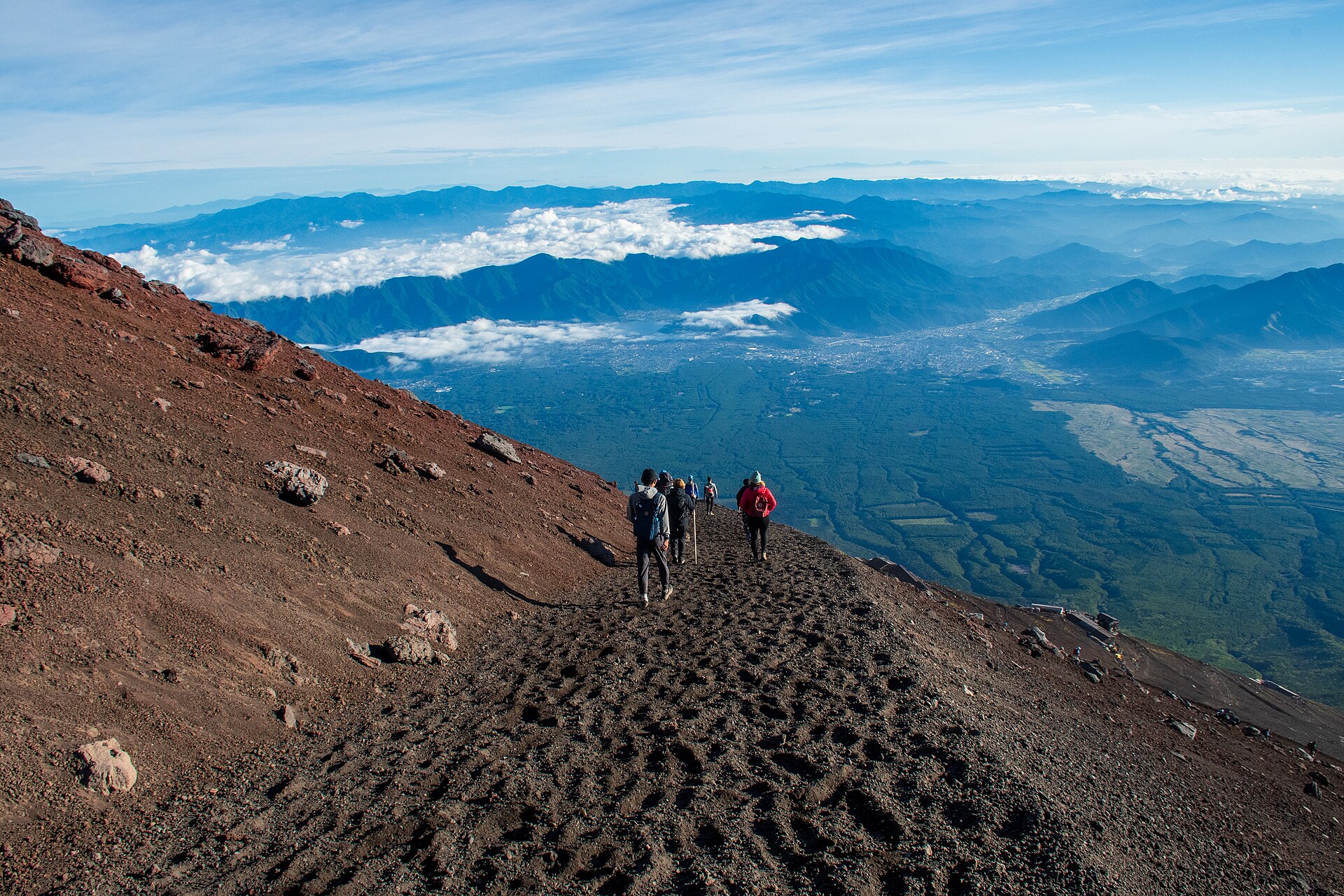
Mount Fuji is not a year-round summit hike. The summit trails are closed outside the designated official summer season. In 2026, the season ended on 10 September, so the closure began on 11 September and continues until the next officially announced opening date. Do not plan an out-of-season ascent. If you are planning for the next official summer season, start by choosing the route that fits your dates and mountain-hut plan: Yoshida is the Yamanashi-side option, while Fujinomiya is the Shizuoka-side option. Then confirm the next season’s dates, fee, capacity and registration rules on the official climbing portal before you book transport or a hut.
- Previous official opening dates
- First: plan only for an official season
- Rules and essential equipment: a quick checklist
- Choose Yoshida when early dates and hut choice matter most
- Choose Fujinomiya when the Shizuoka-side approach fits the trip
- Do not make the 14:00 rule a last-minute problem
- Related guides
Previous official opening dates
| Route | 2025 official season (previous-year record) | What this tells you |
|---|---|---|
| Yoshida Trail | 1 July–10 September | It opened at the start of July in the previous season. |
| Fujinomiya Trail | 10 July–10 September | Its Shizuoka-side season began later in the previous season. |
These are previous-year official dates, not next-season dates. In 2026, the same Yoshida-versus-Fujinomiya pattern applied, but trail openings can be delayed by snow or weather and the authority announces the next season before it begins. Use the table to understand the usual planning window, then use the official announcement as the final answer for your travel year.
| Your priority | Start with | Why it fits | Confirm before booking |
|---|---|---|---|
| Your trip is in the first part of July | Check Yoshida first | In 2026, Yoshida opened earlier than Fujinomiya. | The next official opening dates; do not assume the 2026 calendar repeats. |
| You want the route with the strongest published hut infrastructure | Compare Yoshida | The official FAQ identifies Yoshida as the easier option because it has many mountain huts. | Which huts are open, their booking rules and the exact route access for your date. |
| Your trip approaches from the Shizuoka side | Compare Fujinomiya | It is the Shizuoka-side route and had its own 2026 registration process. | The current FUJI NAVI/QR process, trailhead access and your hut plan. |
| You would arrive at the trail after 14:00 | Book a hut or change the plan | In 2026, both sides restricted entry from 14:00 to 03:00, with a hut-stay exception. | The next season’s time rule and a confirmed reservation; do not attempt an unplanned overnight climb. |
First: plan only for an official season
The official portal separates the four Mount Fuji routes because they differ in distance, elevation, scenery, crowds and hut availability. That is a useful reminder that there is no universally best route. It is also clear about the larger boundary: outside the official season, the trails to the summit are closed. A clear forecast or an open road to a fifth station does not turn a closed trail into a normal visitor activity.
Build the plan in this order: first confirm that your travel dates fall inside the newly announced official season; then choose the trail; then secure the hut and registration required for that route; only after that make non-flexible transport or accommodation bookings. This order avoids the common mistake of choosing a Fuji-region hotel first and discovering that the usable climbing dates, entry rules or overnight plan do not match it.
Rules and essential equipment: a quick checklist
Use these as the 2026 baseline, then check the next season’s official notice before booking. The rules below are not a mountain-hut booking and do not make an out-of-season climb permissible.
| Rule or check | What it meant in 2026 | What to do for your trip |
|---|---|---|
| Official season only | The summit trails were closed outside the designated summer season. | Wait for the official opening announcement; do not substitute a fifth-station visit for trail permission. |
| Late entry | Entry from 14:00 to 03:00 was restricted unless you were staying in a mountain hut. | Reserve the hut directly and make sure its check-in time works; do not plan a bullet climb. |
| Fee and registration | The 2026 hiking fee was ¥4,000, with route-specific online procedures. | Confirm the current route, fee, capacity and registration page before paying for transport. |
| Protect the mountain | Stay on the trail, take all rubbish home, and never remove rocks, plants or lava. | Pack a rubbish bag and follow ranger and hut staff instructions. |
On the Yoshida Trail, the published gate check required cold-weather clothing, separate rain gear and appropriate climbing footwear. The official guide is more specific: use hiking boots with a supportive sole, a separate waterproof jacket and trousers, and warmth layers such as fleece or down, gloves and a neck warmer. Even in summer, the summit can be close to 0°C before sunrise, and weather can change quickly.
Pack this before you leave the fifth station
- Worn or immediately accessible: proper hiking boots, separate waterproof jacket and trousers, warm layers, gloves and neck warmer.
- Safety and navigation: a headlamp with spare battery, a map, a first-aid kit and a written climbing plan; check boot soles and the headlamp before departure.
- Food, water and carrying: a hands-free backpack of about 30L, 1–2 litres of water, high-calorie snacks, cash and 100-yen coins for huts and toilets, plus a rubbish bag.
- Useful protection: hat, sunglasses and sunscreen. Consider a helmet for rockfall and volcanic risk; use trekking-pole caps on crowded trails.
Do not treat the checklist as a promise that every condition will be manageable. If the forecast, your fitness, the route status or the descent time no longer supports a safe plan, turn back or do not start. For a first mountain climb or limited experience, the Yamanashi guidance recommends going with a mountain guide or similarly qualified professional.
Choose Yoshida when early dates and hut choice matter most
For an early-July plan, Yoshida is the first route to check because its 2026 official season began on 1 July, nine days before Fujinomiya. The official FAQ also says Yoshida is comparatively easier because of its many mountain huts. That does not make it a casual walk: the route still needs an appropriate season, a realistic pace, weather-ready equipment and a confirmed place to sleep if your schedule reaches the trailhead late.
Yamanashi’s 2026 rules set a ¥4,000 hiking fee, a daily 4,000-person limit and a gate restriction from 14:00 to 03:00. A climber with a mountain-hut reservation could pass during those hours, but an unreserved late start was not the alternative. Use those figures to understand why the hut comes before the last bus or hotel booking; verify every part again when the next season’s rule page is published.
{{image:yoshida}}Choose Fujinomiya when the Shizuoka-side approach fits the trip
Start with Fujinomiya when the Shizuoka side is the natural fit for your wider journey and you are willing to organise that route’s own entry process. For 2026, the official Shizuoka notice required every climber on Fujinomiya, Gotemba and Subashiri to pre-register in FUJI NAVI and present the issued QR code at the gate. It also required a mountain-hut reservation for entry from 14:00 to 03:00. These are not details to solve at the trailhead.
The right question is not whether Fujinomiya is “better” than Yoshida in the abstract. Ask whether its official dates, route-side access, registration process and available hut make a robust plan for your exact night. If your dates sit in the early-July gap that existed in 2026, or you cannot secure the required overnight plan, switch the route or the dates rather than trying to force an unsuitable climb.
{{image:fujinomiya}}Do not make the 14:00 rule a last-minute problem
The most consequential shared 2026 rule was the 14:00–03:00 restriction. The official site presents it as a measure against unsafe late starts and unplanned overnight climbing. If delayed transport would put you at a gate after 14:00, do not treat a sprint to the trailhead as the backup. Choose a confirmed mountain hut, move the climb to the following day, or reshape the itinerary. The correct action next season will depend on the then-current rules, but the decision principle is stable: a late arrival needs a safe, authorised plan before the trip begins.
- Choose dates first: wait for the official season announcement and select a route that is actually open on those dates.
- Choose the route second: use Yoshida for an early-July or hut-choice comparison; use Fujinomiya when the Shizuoka-side plan and its current process fit better.
- Reserve the hut before fixed transport: a late trailhead arrival needs a real reservation, not a hopeful same-day decision.
- Complete the current entry process: fee, capacity and pre-registration rules can change by route and year.
- Check conditions again before travelling: the official Mount Fuji climbing site is the authority for opening dates, restrictions and live notices.
For the wider trip around the mountain, continue with the Yamanashi travel guide, the Shizuoka travel guide, and the Kanagawa travel guide. If viewing Mount Fuji is the goal rather than climbing it, a Fuji-region stay can be the better plan outside the official climbing season.
Sources checked: the official Mount Fuji climbing portal, the 2026 Yamanashi notice, the 2026 Shizuoka notice, the Yoshida restrictions notice, and things to know before climbing, and the official off-season warning. Checked 2026-09-13. Confirm next season’s rules before booking.